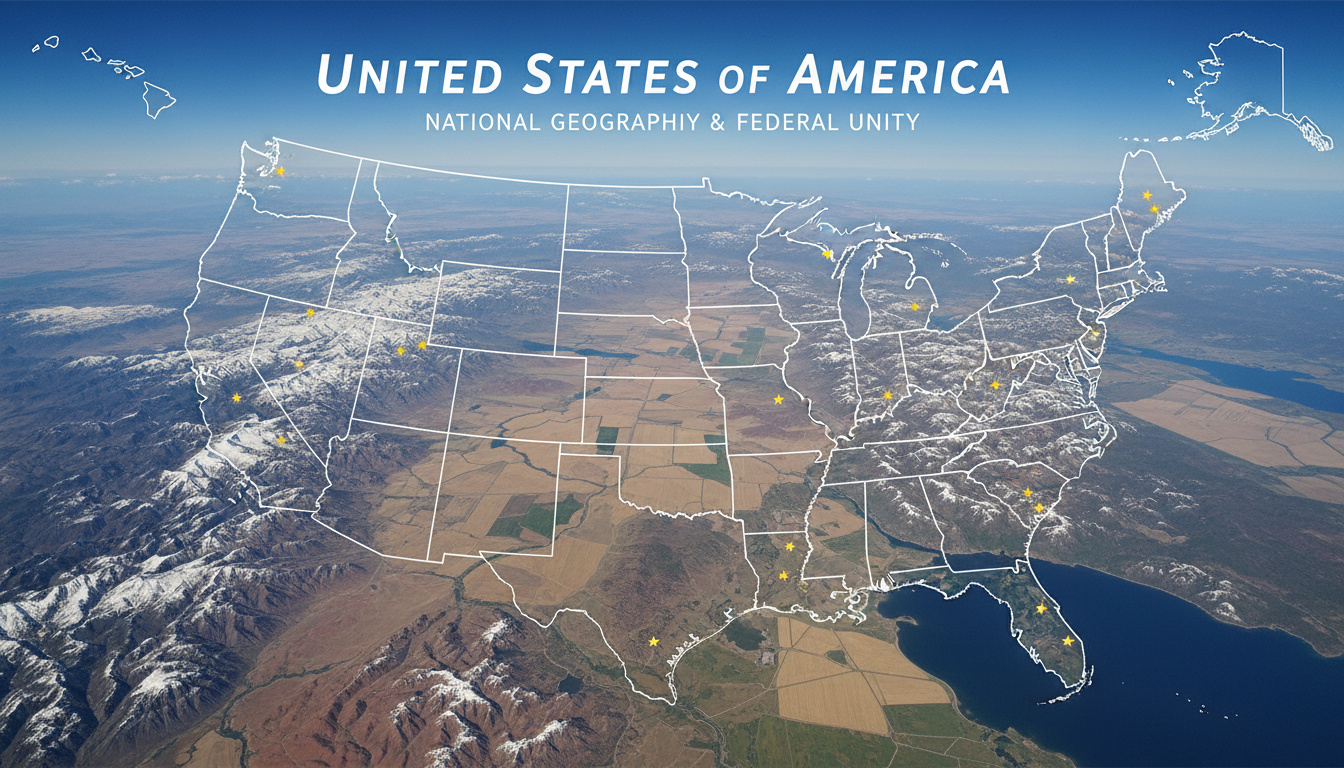
The United States of America operates as a federal republic comprising 50 distinct states, each maintaining its own capital city while sharing sovereignty with a central federal government. This complex political structure spans a vast geographic area, from the Atlantic seaboard to the Pacific Ocean, incorporating diverse climates and administrative systems under a unified constitutional framework.
Understanding the composition of these states requires examining both their individual governance structures and their collective relationship to the federal authority based in Washington, DC. The following analysis draws exclusively from geographic and governmental mapping sources to outline the definitive boundaries, capitals, and organizational principles that define the American federation today.
What Is the United States of America?
United States of America (USA or US)
50
Washington, DC
Federal Republic
- The federation consists of exactly 50 states, a fixed number consistently reported across geographic databases.
- Alaska represents the largest territory by land area, while Rhode Island comprises the smallest.
- Washington, DC functions as the federal capital, operating independently from any state jurisdiction.
- Each state maintains its own capital city housing distinct legislative and executive bodies.
- The constitutional framework establishes shared sovereignty between state and federal authorities.
- County subdivisions exist within states but lack independent sovereign status.
| Fact | Details |
|---|---|
| Total States | 50 |
| Federal Capital | Washington, DC |
| Largest State (Area) | Alaska |
| Smallest State (Area) | Rhode Island |
| Government Structure | Federal Republic |
| State Sovereignty | Shared with federal government |
| Non-Contiguous States | Alaska, Hawaii |
| Administrative Subdivisions | Counties (without sovereignty) |
How Many States Are in the United States?
The Complete Enumeration
The United States comprises exactly 50 states, a figure confirmed by multiple cartographic and governmental sources. This total includes the 48 contiguous states located on the North American continent, plus Alaska and Hawaii, which occupy non-contiguous territories.
Geographic Distribution
The 48 contiguous states stretch from the Atlantic Ocean to the Pacific, bordered by Canada to the north and Mexico to the south. Alaska occupies the northwestern extremity of the continent, separated from the contiguous states by Canadian territory. Hawaii constitutes an archipelago in the central Pacific Ocean.
Alaska encompasses the largest total land area among all states, while Rhode Island holds the distinction of the smallest geographic footprint, according to Maps of World.
Cartographic Documentation
Multiple authoritative sources provide detailed visual documentation of the 50 states and their capitals. These resources typically display the 48 contiguous states with separate insets for Alaska and Hawaii, clearly delineating state boundaries and capital locations. GIS Geography and On The World Map maintain updated reference materials showing these geographic relationships.
Educational repositories, including Arizona State University GeoAlliance and Waterproof Paper, distribute printable PDF maps detailing state boundaries and capital cities for reference purposes.
What Is the Capital and Who Leads the US Government?
The Federal District
Washington, DC serves as the national capital, housing the federal government’s primary operations. The district borders Virginia and Maryland but maintains separate administrative status as a federal entity, not a state. 50States.com confirms this designation alongside its comprehensive capital listings.
State-Level Capitals
Each of the 50 states maintains its own capital city where state legislatures convene and executive offices operate. These range from Montgomery, Alabama, to Cheyenne, Wyoming, forming a network of decentralized governance centers that complement the federal structure in Washington.
Executive Leadership
Geographic mapping sources do not contain current information regarding the President of the United States. Current executive leadership requires verification through official federal communications channels.
When Was the United States Founded?
Geographic sources focus primarily on administrative structures rather than historical chronology. While 1776 is commonly associated with the Declaration of Independence, specific timelines and founding documentation remain outside the scope of cartographic materials.
Geographic mapping data from MyConnectSuite and other providers focus exclusively on current state boundaries and capitals, omitting historical development sequences.
Chronology of National Formation
The chronological sequence of United States founding remains undocumented in geographic sources. While general knowledge associates 1776 with the Declaration of Independence and 1787 with the Constitutional Convention, cartographic materials do not verify these specific dates.
- 1776: Commonly associated with the Declaration of Independence.
- 1787: Associated with the Constitutional Convention.
- Present: Federal structure of 50 states confirmed as current status.
Verified Information and Unresolved Questions
| Established Information | Information Not Available in Sources |
|---|---|
| The United States consists of exactly 50 states. | Specific founding dates and detailed historical timelines. |
| Washington, DC serves as the federal capital. | Current President or executive leadership details. |
| Each state maintains a designated capital city. | Current population statistics for states or nation. |
| Alaska is the largest state; Rhode Island is the smallest. | Gross Domestic Product (GDP) figures. |
| The government operates as a federal republic with shared sovereignty. | Historical specifics regarding the 1776 founding documents. |
Federal Governance Structure
The United States functions as a federal republic where sovereignty is constitutionally divided between the central government and the individual states. This arrangement allows states to maintain distinct legal codes and administrative systems while participating in a unified national framework.
State governments operate from their designated capitals, exercising authority over local matters. Counties and equivalent subdivisions provide additional administrative layers, though these entities do not possess sovereign powers comparable to the states. NSW operates under a similar federal structure within Australia, where state governments retain significant autonomy alongside national authority.
Sources and Documentation
The U.S. is a federal republic where 50 states share sovereignty with the federal government.
Maps of World Geographic Database
Washington, DC, serves as the national capital for federal operations.
GIS Geography
State capitals house state governments and legislatures.
50States.com Reference
Summary of Findings
The United States of America comprises 50 states operating under a federal republic structure, with Washington, DC serving as the national capital and each state maintaining its own governmental seat. While geographic sources confirm the complete list of states and capitals along with area classifications—identifying Alaska as largest and Rhode Island as smallest—information regarding current executive leadership, specific founding dates, and demographic statistics requires consultation of additional official resources. For international comparative context, major administrative centers like São Paulo demonstrate similar governance complexity within their respective federal systems.
Frequently Asked Questions
Is Washington DC one of the 50 states?
No. Washington DC is the federal capital district, not a state. It borders Maryland and Virginia and houses federal operations separately from state jurisdictions.
How many states are in the contiguous United States?
Forty-eight states are contiguous, located on the North American continent without separation. Alaska and Hawaii are non-contiguous.
What is the difference between a state capital and the federal capital?
State capitals house individual state governments and legislatures for each of the 50 states. Washington DC serves as the federal capital for national government operations.
Which US state has the smallest land area?
Rhode Island possesses the smallest geographic footprint among all 50 states, while Alaska maintains the largest.
Do counties in the United States have the same power as states?
No. Counties are administrative subdivisions within states and lack the sovereignty that states share with the federal government.
Are there 52 states in the United States?
No. The United States consists of exactly 50 states, plus the District of Columbia as the federal capital.
Where can I find a map of all 50 states and capitals?
Comprehensive maps showing all 50 states and capitals are available through GIS Geography and On The World Map, including insets for Alaska and Hawaii.
Related stories


Liam O'Brien covers Australian politics and public affairs for Aussie Pulse.