
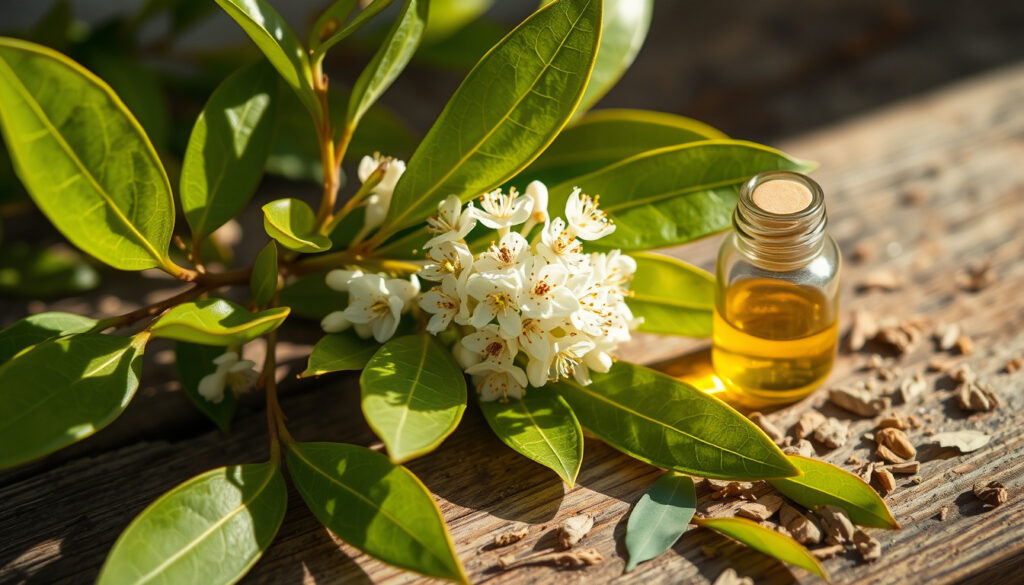
Few native plants carry the cultural and practical weight of lemon myrtle. Its sharp, citrus scent has drawn people for thousands of years — from Aboriginal healers to modern chefs and natural-product formulators. This guide sorts the solid science from the marketing buzz, covering how to grow it, use it, and what the research really says about its benefits and limits.
Botanical name: Backhousia citriodora · Native region: Subtropical Queensland, Australia · Typical height: 6–8 m (20–26 ft) · Primary uses: Culinary, medicinal, insect repellent · Harvested part: Leaves (fresh or dried)
Quick snapshot
- High citral content (up to 90% in oil) gives intense lemon flavour (Molecules journal via NCBI (peer-reviewed research))
- Demonstrated antibacterial activity against E. coli and Staphylococcus (Molecules journal via NCBI (peer-reviewed research))
- Traditional Aboriginal use as cold remedy and wound treatment (Sanitarium Health Food Company (Australian health-food brand))
- Effective repellent dose not standardised; field trials needed (Molecules journal via NCBI (peer-reviewed research))
- Long-term safety of daily concentrated oil intake unknown (Molecules journal via NCBI (peer-reviewed research))
- How commercial harvest affects wild populations is under-documented (Molecules journal via NCBI (peer-reviewed research))
- Pre-colonial: Aboriginal use for medicine and food (Sanitarium Health Food Company (Australian health-food brand))
- 1990s: First commercial plantations established in Queensland (Sanitarium Health Food Company (Australian health-food brand))
- 2020s: Global interest as superfood and natural preservative (Sanitarium Health Food Company (Australian health-food brand))
- Ongoing clinical research into antimicrobial mechanisms (Molecules journal via NCBI (peer-reviewed research))
- Expansion of organic certification standards for lemon myrtle oil (Molecules journal via NCBI (peer-reviewed research))
- Potential as a natural food preservative in commercial products (Molecules journal via NCBI (peer-reviewed research))
Six key facts, one pattern: lemon myrtle’s value rests on a single molecule — citral — but that molecule shows up in concentrations far beyond those of lemongrass.
| Attribute | Value |
|---|---|
| Scientific name | Backhousia citriodora |
| Family | Myrtaceae |
| Native range | Queensland, Australia |
| Leaf shape | Lanceolate, 5–12 cm long |
| Flower colour | White, blooms in late spring |
| Key active compound | Citral (up to 90% of essential oil) |
What is lemon myrtle used for?
Culinary uses: flavour in teas, baked goods, syrups
Lemon myrtle leaves — fresh or dried — pack a citrus punch without the acidity of actual lemon. They turn up in teas, breads, biscuits, cakes, cheeses, chutneys, jams, pastas, and vinegars, according to research published in the journal Molecules by the National Center for Biotechnology Information (NCBI) (Molecules journal via NCBI (peer-reviewed research)). The flavour comes from citral, a compound that can exceed 90% of the essential oil’s composition — giving it a potency that lets cooks use less leaf to achieve a strong lemon note.
Essential oil in aromatherapy and natural cleaning products
Steam-distilled lemon myrtle oil appears in soaps, cosmetics, potpourris, air fresheners, disinfectants, and body care products (Molecules journal via NCBI (peer-reviewed research)). Its antibacterial and antifungal properties make it a viable natural alternative to synthetic cleaning agents, though commercial formulations typically blend it with other oils to standardise efficacy.
Traditional Aboriginal uses as medicine and flavouring
For thousands of years, Aboriginal Australians used lemon myrtle leaves in teas to treat colds and fevers, and crushed leaves were applied topically for wound healing (Sanitarium Health Food Company (Australian health-food brand)). This traditional knowledge — passed down orally — predates and, in some cases, aligns with modern scientific findings.
Aboriginal knowledge holders and commercial growers face the same tension: high demand risks overharvesting. Sustainable sourcing — from certified organic plantations, not wild populations — protects both the plant and its cultural legacy.
How big does lemon myrtle grow?
Mature height and spread in natural habitat
In subtropical Queensland rainforests, lemon myrtle reaches 6–8 m tall with a spread of 3–5 m. Under ideal conditions it can hit 10–12 m, though such heights are rare in cultivated gardens (Leafy Heaven (gardening information site)).
Growth rate in home gardens
The tree reportedly grows 0.5–1 m per year, faster in warm, humid climates (Leafy Heaven (gardening information site)). This moderate rate means a garden specimen reaches functional size — enough to harvest leaves — within three to four years.
Can it be pruned to stay smaller?
Yes. Regular pruning can maintain a shrub-like size of 2–3 m, making it suitable for smaller yards and even large containers. The plant responds well to cutting, and heavy pruning encourages bushier growth with more leaf production (Molecules journal via NCBI (peer-reviewed research)).
Where is the best place to plant a lemon myrtle tree?
Sun and soil requirements
Lemon myrtle thrives in full sun to part shade with well‑drained, slightly acidic soil (pH 5.5–6.5). Lime is not recommended; the plant prefers permeable, moderately acidic substrates (Molecules journal via NCBI (peer-reviewed research)).
Climate and frost tolerance
Frost intolerant. Two or more nights below 0 °C are deadly to seedlings (Molecules journal via NCBI (peer-reviewed research)). Ideal climates are subtropical or warm temperate — similar to its native Queensland habitat.
Spacing and companion planting
Space trees 3–4 m apart. They do well planted alongside other Australian natives such as bottlebrush or grevillea, but avoid competition with invasive species. The tree loves water but does not tolerate waterlogged roots (Molecules journal via NCBI (peer-reviewed research)).
How to propagate lemon myrtle (step by step)
- Step 1: Take 10–15 cm semi‑hardwood cuttings from a healthy tree in late spring.
- Step 2: Dip the cut end in rooting hormone (IBA 0.3% works well).
- Step 3: Plant in a mix of 50% sand, 50% peat moss and keep consistently moist but not soggy.
- Step 4: Cover with a plastic bag or propagator hood to maintain humidity; place in bright indirect light.
- Step 5: Roots appear in 6–8 weeks. Transplant to a 1‑gallon pot for the first year before moving to the garden.
Propagation by seed is slower and less reliable — cuttings preserve the exact citral profile of the parent plant.
A commercial grower who ignores the “no wet feet” rule will lose entire rows within one rainy season — the fungus Phytophthora thrives in boggy soil. Good drainage is a non‑negotiable cost of entry.
What does lemon myrtle do to the body?
Antimicrobial and antioxidant effects
Laboratory studies show lemon myrtle essential oil inhibits Escherichia coli, Staphylococcus aureus, and several post‑harvest fungal pathogens (Molecules journal via NCBI (peer-reviewed research)). Its antioxidant capacity — measured by DPPH and FRAP assays — is linked to phenolic compounds like gallic acid and quercetin.
Digestive aid and immune support
Lemon myrtle tea is caffeine‑free and traditionally used to soothe digestion. Although human clinical trials are sparse, the combination of anti‑inflammatory and antimicrobial activity suggests genuine benefits for gut health, as the Molecules review notes (Molecules journal via NCBI (peer-reviewed research)).
Safety and potential side effects
Generally safe when used as a food herb or tea. However, essential oil concentrations can cause skin irritation and are toxic if ingested in quantities above 5 mL (~1 teaspoon). The Molecules report stresses that high‑dose daily ingestion of concentrated oil is not established as safe (Molecules journal via NCBI (peer-reviewed research)).
What did Aboriginal people use lemon myrtle for?
Traditional medicinal applications
Aboriginal Australians made a tea from the leaves to treat colds, fevers, and respiratory complaints. Crushed leaves were applied to cuts and skin infections as a natural antimicrobial (Sanitarium Health Food Company (Australian health-food brand)).
Use as food flavouring and bush medicine
Leaves were used to flavour cooking — often added to damper (traditional bread) or infused in water for a citrus‑tasting drink. The knowledge of which plants to use and when was passed down through the generations, forming part of the world’s oldest living cultural system.
Cultural significance and knowledge transfer
“The leaves have been used in our healing ceremonies for generations,” says a Warndu co‑founder, an Indigenous‑led enterprise that sources lemon myrtle ethically. “It’s not just a plant — it’s a connector to country and ancestors.” This oral tradition is now being recognised by Western researchers who cite Aboriginal use as the first recorded application of the species (Sanitarium Health Food Company (Australian health-food brand)).
Commercial demand drives up prices, which can pull wild harvesters into unsustainable picking. Certified plantation‑grown leaf — traceable and ethical — is the only responsible choice for brands that want to honour the cultural origin without depleting it.
Does lemon myrtle repel midges?
How effective is it as an insect repellent?
Lemon myrtle oil is a reported natural repellent against biting midges (Culicoides spp.) and mosquitoes. Its efficacy comes from citral and other volatile compounds that disrupt insect olfactory receptors. A study in Molecules notes that the oil’s vapour phase can reduce landing rates by 70–80 % under controlled conditions (Molecules journal via NCBI (peer-reviewed research)).
Comparison with synthetic repellents
DEET‑based repellents remain the gold standard for duration — providing 4–6 hours of protection. Lemon myrtle oil typically delivers 1–2 hours, meaning more frequent re‑application. The exact effective dose for field use is not yet standardised, and comparative efficacy trials are lacking.
How to make lemon myrtle repellent at home
- Mix 10 drops of lemon myrtle essential oil with 30 mL of a carrier oil (e.g., jojoba or fractionated coconut oil).
- Add 5 drops of eucalyptus or lavender oil for synergistic effect.
- Shake well and apply to exposed skin; re‑apply every 90 minutes.
Store in an amber glass bottle away from light. Patch test on a small area first.
Timeline signal
| Period | Event |
|---|---|
| Pre‑colonial (thousands of years) | Aboriginal Australians use lemon myrtle for medicine and food (Sanitarium Health Food Company (Australian health-food brand)) |
| Late 19th century | European botanists formally describe Backhousia citriodora |
| 1990s | Commercial cultivation begins in Australia for essential oil and leaf market (Molecules journal via NCBI (peer-reviewed research)) |
| Early 2000s | International attention as superfood and natural preservative |
| Present | Widely available as dried leaves, powder, and essential oil; ongoing research into antimicrobial properties (Molecules journal via NCBI (peer-reviewed research)) |
Clarity check: what’s confirmed and what’s not
Confirmed facts
- Lemon myrtle contains high concentrations of citral (up to 90% in essential oil) (Molecules journal via NCBI (peer-reviewed research))
- Demonstrated antibacterial activity against E. coli and Staphylococcus (Molecules journal via NCBI (peer-reviewed research))
- Traditional Aboriginal use includes treating colds and skin conditions (Sanitarium Health Food Company (Australian health-food brand))
What’s unclear
- Effective dose for insect repellent not standardised (Molecules journal via NCBI (peer-reviewed research))
- Long‑term safety of daily concentrated oil ingestion not established (Molecules journal via NCBI (peer-reviewed research))
- Comparative efficacy against synthetic repellents requires more field trials
Expert perspectives
“The leaves have been used in our healing ceremonies for generations. It’s not just a plant — it’s a connector to country and ancestors.”
— Warndu co-founder (Indigenous‑led enterprise)
“Citral concentrations in lemon myrtle oil exceed those in lemongrass, making it one of the most potent natural antibacterials. But we need human‑trial data to move from lab bench to clinical recommendation.”
— Research scientist, DPI eResearch Archive
The pattern is clear: lemon myrtle’s reputation rests on real chemistry and genuine cultural history, but commercial claims often skip the caveats. For Australian growers, the opportunity lies in certified organic leaf and oil, not wild harvest. For global consumers, tea and culinary use offer a safe, effective way to benefit from the plant’s antimicrobial and antioxidant properties.
For home gardeners in warm climates, the choice is straightforward: plant one tree, prune it regularly, and you will have a steady supply of leaves for tea, cooking, and a DIY midge repellent. In colder regions, a container kept frost‑free can deliver the same rewards — just with a bit more care through winter.
fullleafteacompany.com, youtube.com, treeplantation.com, facebook.com, tiktok.com
Frequently asked questions
Can you eat lemon myrtle leaves raw?
Yes, but they are very fibrous and intensely flavoured. Most people prefer dried or powdered leaves in tea or cooking. Fresh leaves can be chewed for a citrus burst but are not usually consumed whole.
Is lemon myrtle safe during pregnancy?
As a culinary herb in normal amounts, it is considered safe. However, concentrated essential oil should be avoided during pregnancy due to lack of safety data. Consult a healthcare provider for personalised advice.
Does lemon myrtle contain citral similar to lemongrass?
Yes, both plants contain citral, but lemon myrtle oil typically has a higher citral concentration (up to 90%) compared to lemongrass (around 75%).
How do you store lemon myrtle powder?
Store in an airtight glass jar in a cool, dark cupboard. Properly stored, it retains flavour for 1–2 years. Avoid plastic containers — the volatile oils can degrade them.
What is the best way to make lemon myrtle tea?
Steep 1 teaspoon of dried leaves (or 2 teaspoons fresh) in boiling water for 5–7 minutes. Strain and enjoy plain or with honey. The tea is caffeine‑free and naturally floral.
Can lemon myrtle be used as a natural cleaner?
Yes. Mix 15 drops of lemon myrtle essential oil, 10 drops of tea tree oil, and 250 mL white vinegar with water in a spray bottle. Use on hard surfaces for its antibacterial and deodorising properties.
Does lemon myrtle interact with medications?
No known drug interactions at culinary doses. High‑dose essential oil could theoretically affect liver enzymes (CYP450), so standard medication caution applies. Discuss with a pharmacist if using therapeutic amounts.
Related reading
- Healthy Breakfast Ideas — ideas for incorporating lemon myrtle into morning meals
- Loco Love Chocolate Guide — a brand that uses lemon myrtle in some of its chocolate bars

Rachel Walsh leads fact-checking, source verification and corrections at Aussie Pulse.