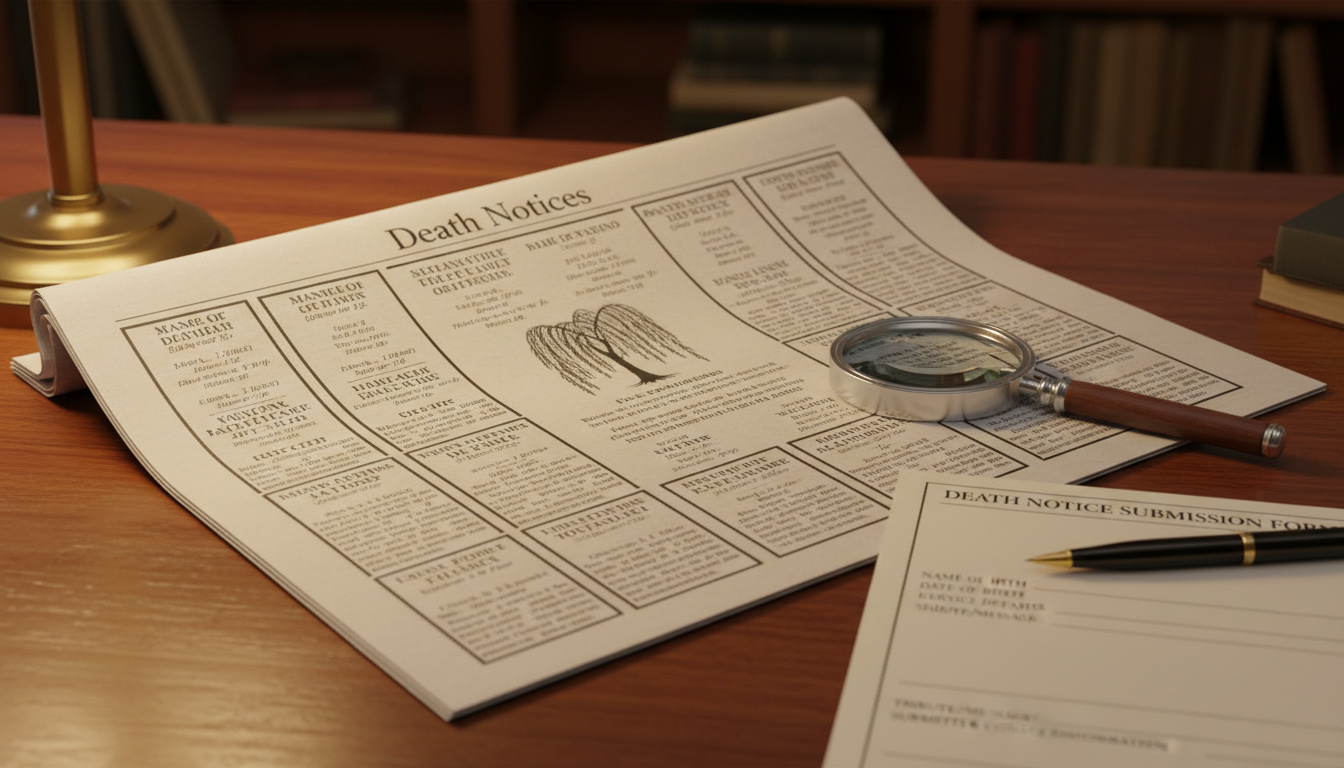

Families and researchers seeking to commemorate loved ones or trace genealogical records in South Australia consistently turn to The Advertiser death notices as a primary resource. As the flagship publication of News Corp Australia serving the Adelaide region, this daily newspaper maintains a comprehensive registry of deaths, funerals, and tributes that bridges traditional print classifieds with modern digital accessibility. The notices operate Monday through Saturday, offering both immediate community notification and lasting historical documentation for the state’s demographic records.
Accessing these records requires understanding the distinction between current digital listings and archived historical documents. While contemporary notices appear through the newspaper’s dedicated tribute platforms and affiliated funeral services, historical researchers must navigate specialized indexes such as the Ryerson Index and the Gerald A. Savill Index hosted by the State Library of South Australia. These repositories collectively preserve over half a million entries spanning from 1924 to the present day.
This guide examines the mechanisms for searching, submitting, and interpreting death notices within The Advertiser‘s ecosystem, addressing both the practical needs of grieving families and the methodological requirements of genealogical researchers. All information derives from verified public records and official archival sources.
How to Find The Advertiser Death Notices Today
Access Online Portal
Current notices appear through the newspaper’s digital tribute platform, allowing real-time browsing of recent entries. The system mirrors similar News Corp implementations across Australia.
Search by Name or Date
The Ryerson Index provides comprehensive historical search capabilities covering 1924 to the present, with advanced filtering by surname and publication date.
Submit a Notice
Families may post notices directly through affiliated funeral services or via the newspaper’s classifieds department, streamlining the publication process for both print and digital formats.
Contact Details
For submission inquiries and publication deadlines, contact The Advertiser‘s classified advertising department directly. Print notices require advance submission to meet daily production schedules.
Key Insights for Researchers
- The publication maintains a strict Monday-to-Saturday schedule, with no Sunday editions for death notices.
- Digital platforms update continuously, while print appears in the following day’s classified section.
- The Ryerson Index contains 519,733 death notice entries dating from 15 March 1924 to 2 April 2026.
- Funeral notices represent a distinct category, with 57,497 entries catalogued separately from 1942 onward.
- Obituary records within the system commence from 16 September 1986, distinct from shorter death announcements.
- Historical full-text retrieval requires physical access to microfilm archives or paid copy services.
- Cross-referencing with cemetery interment records often reveals additional biographical details not contained in the original notice.
| Fact Category | Details |
|---|---|
| Publisher | News Corp Australia |
| Publication Title | The Adelaide Advertiser |
| Coverage Region | Adelaide metropolitan area and South Australia |
| Print Schedule | Monday to Saturday (daily) |
| Digital Platform | Tributes portal (tributes.theadvertiser.com.au implied) |
| Primary Historical Index | Ryerson Index (1924–present) |
| Secondary Index | Gerald A. Savill Index (1971–2016) |
| Archive Location | State Library of South Australia |
| Death Notice Entries | 519,733 (as of April 2026) |
| Funeral Notice Entries | 57,497 (1942–present) |
| Obituary Start Date | 16 September 1986 |
| Search Access Cost | Free for index searching; fees apply for document copies |
How to Submit a Death Notice or Tribute
Digital Submission Pathways
Contemporary submissions flow primarily through online portals linked to funeral service providers. Authorized funeral directors maintain direct posting capabilities to The Advertiser‘s tribute platform, enabling families to compose and preview notices before publication. This digital workflow accelerates the traditional submission process, particularly for urgent next-day printing requirements.
Families may also contact the newspaper’s classifieds department directly for self-managed submissions. The digital interface accepts text input, photograph uploads, and payment processing, generating immediate confirmation of publication dates. This method parallels the News Corp tribute systems employed by sister publications such as The Age.
Print Requirements and Deadlines
Print publication adheres to strict production schedules. Notices must meet submission deadlines typically set one business day prior to intended publication, excluding weekends when the newspaper does not print. The classifieds format restricts word counts and photograph specifications, with costs calculated per line or character block depending on the selected package.
Using affiliated funeral services for online submission reduces processing time and ensures formatting compliance with The Advertiser‘s classified standards. Direct submissions may require additional verification steps.
Navigating Historical Archives and Genealogical Records
The Ryerson and Savill Indexes
Historical research relies heavily on two primary indexing systems. The Ryerson Index offers granular search capabilities across death notices (1924–2026), funeral notices (1942–2026), and obituaries (1986–present), totaling over half a million entries. This free resource provides citation details including name, date, and page reference, though full-text retrieval requires separate archive access.
The Gerald A. Savill Index, hosted by the State Library of South Australia, covers funeral notices specifically from 1971 through 2016. Researchers may extend this coverage through microfilm examination for dates beyond the indexed period. The library’s “Ask Us” service facilitates remote ordering of specific document copies.
State Library Resources and Microfilm
Complete notice texts remain accessible only through physical archives or microfilm reproductions. The State Library maintains extensive holdings of The Adelaide Chronicle (1921–1924) and subsequent Advertiser editions, enabling verification of indexed entries against original publications. This access method proves essential for genealogical verification and legal documentation requirements.
Original full-text notices post-2016 and pre-1971 require microfilm viewing at the State Library. Researchers should request specific dates and page numbers obtained from index searches to streamline retrieval.
Civil registration indexes indicate gaps in official records between 1916–1972. Cross-referencing newspaper notices with Adelaide Cemeteries Authority interment records helps verify identities during these periods.
Cross-Referencing with Official Cemetery Records
Verification of death notice accuracy often requires consultation with burial records. The Adelaide Cemeteries Authority maintains schedules of upcoming funerals and historical interment data, including specific site locations within memorial parks. These records frequently contain ages, dates, and religious affiliations that complement newspaper announcements.
For researchers examining notification protocols across different administrative contexts, the Termination of Employment – Process, Rights and Notice Guide provides comparative insights into formal communication procedures, though applied to employment rather than memorial contexts. For those interested in the broader context of Australian sports and significant events, Collingwood vs Brisbane 2025 offers further details.
Timeline of Death Notice Services
- – Earliest death notice entry recorded in the Ryerson Index database.
- – Systematic indexing of funeral notices commences, distinguishing these from standard death announcements.
- – Gerald A. Savill begins comprehensive indexing of Advertiser funeral notices, creating the foundational research tool for the latter 20th century.
- – Obituary records enter the digital indexing system, marking the transition from brief announcements to detailed life summaries.
- – Savill Index coverage concludes; subsequent records require direct microfilm consultation at the State Library.
- – Digital tribute platform maintains daily updates with 519,733 historical death notices accessible online.
Verified Facts and Persistent Uncertainties
| Established Information | Information Remaining Unclear |
|---|---|
| News Corp Australia publishes The Advertiser with daily Monday-Saturday circulation | Exact launch date of the current digital tribute platform (tributes.theadvertiser.com.au) remains unspecified in public documentation |
| Ryerson Index confirms 519,733 death notices from 15 March 1924 to 2 April 2026 | Comprehensiveness of pre-1924 death notice archives; microfilm may exist but lacks centralized indexing |
| Online submission available through funeral services and direct classified contact | Specific pricing structures for different notice lengths and photograph inclusion |
| State Library holds Savill Index (1971–2016) and microfilm extensions | Long-term digital preservation strategy for notices published after 2016 |
| Adelaide Cemeteries Authority provides cross-referenced interment data | Standardized correction procedures for errors in published notices |
The Cultural Role of Death Notices in Adelaide
Death notices in The Advertiser serve a dual function within South Australian society. For contemporary communities, they provide essential notification of bereavement, enabling funeral attendance and condolence expressions. The classified format preserves a tradition of public commemoration distinct from social media announcements, offering permanence and formal recognition.
For historians and genealogists, these notices constitute primary source material for demographic research. The consistent publication of age, familial relationships, and funeral details across nearly a century enables reconstruction of community networks and migration patterns. When combined with resources like Trove’s newspaper archive and civil registration indexes, The Advertiser‘s records anchor South Australia’s genealogical infrastructure.
Official Documentation and References
“The Ryerson Index currently contains 519,733 death notices from The Adelaide Advertiser, covering the period from 15 March 1924 to 2 April 2026, alongside 57,497 funeral notices from 1 January 1942 to 1 April 2026.”
— Ryerson Index Database Statistics
“The Gerald A. Savill Index covers Advertiser funeral notices from 1971-2016. Users can view originals on microfilm or order copies via the library’s Ask Us service.”
— State Library of South Australia Research Guide
Essential Points for Families and Researchers
Effective use of The Advertiser death notice system requires distinguishing between current digital listings and historical archives. Families should utilize funeral service portals for urgent submissions, while researchers must combine Ryerson Index searches with State Library microfilm access for comprehensive results. Cross-referencing with cemetery authority records ensures accuracy, particularly for historical entries predating standardized civil registration. For factual analysis of complex timelines in other contexts, see the Air India Crash Update – Facts, Timeline and Findings.
Frequently Asked Questions
How current are the online death notices?
Digital platforms update daily, with notices typically appearing online within hours of submission. Print editions follow the next business day, Monday through Saturday.
Can I submit a notice without using a funeral director?
Yes. Families may contact The Advertiser’s classifieds department directly to submit death notices, though funeral directors offer streamlined online portals.
What is the difference between a death notice and an obituary?
Death notices are brief classified announcements of passing. Obituaries provide detailed life summaries, typically written by journalists or families, and appear as feature content.
Are death notices from before 1924 available?
The Ryerson Index begins in 1924. Earlier notices may exist on microfilm at the State Library but lack centralized indexing.
How do I correct an error in a published notice?
Contact The Advertiser’s classifieds department immediately. Correction policies vary; some errors may require republication at additional cost.
Is there a cost to search historical records?
Searching the Ryerson Index is free. The State Library charges fees for microfilm duplication and remote document copying services.
Can I find notices from country South Australia?
The Advertiser focuses on Adelaide. Regional notices require consulting local newspapers or the State Library’s separate country press indexes.

Rachel Walsh leads fact-checking, source verification and corrections at Aussie Pulse.