
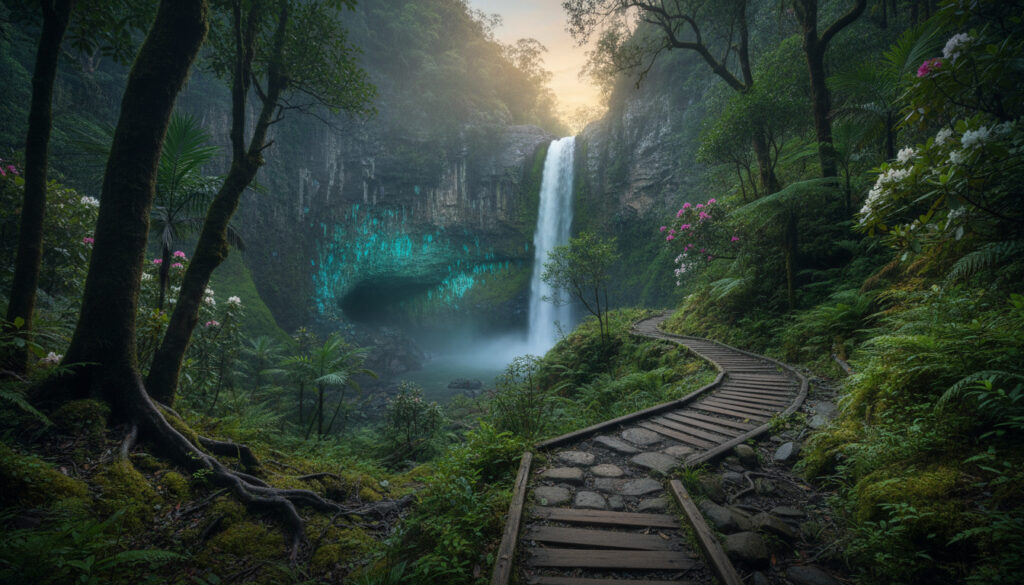
Springbrook National Park occupies 6,197 hectares of the Gold Coast hinterland in Queensland, preserving one of Australia’s most accessible UNESCO World Heritage-listed rainforests. The park contains remnant Gondwana vegetation dating back 100 million years, volcanic formations, and bioluminescent glow worm colonies situated within an hour’s drive of Surfers Paradise.
Ancient Antarctic Beech trees share ridgelines with lookouts offering panoramic coastal views, while nocturnal tours reveal glow worms illuminating basalt caves. The subtropical climate sustains diverse ecosystems that range from dense rainforest to open eucalypt forest, creating varied hiking opportunities across multiple circuit trails.
Where Is Springbrook National Park and How to Get There?
- Entry is free for all day visitors to the national park.
- The park forms part of the Gondwana Rainforests of Australia World Heritage Area.
- Vegetation lineages within the park trace back 100 million years to the supercontinent era.
- Natural Bridge hosts one of Australia’s most accessible glow worm colonies.
- Trail distances range from 10-minute strolls to 54-kilometer multi-day treks linking Lamington National Park.
- No public transport services the park; private vehicle access is required via Nerang-Murwillumbah Road or the Pacific Motorway.
| Attribute | Detail |
|---|---|
| Established | 1990 (sections protected since 1908) |
| Area | 6,197 hectares |
| Status | UNESCO World Heritage |
| Entry Fee | Free |
| Climate | Subtropical (10°C–30°C) |
| Main Access | 1-hour drive from Gold Coast |
| Key Attraction | Natural Bridge |
| Popular Trail | Purling Brook Falls Circuit |
| Camping | The Settlement Campground |
Best Walks and Things to Do in Springbrook National Park
Trail documentation indicates the park offers routes ranging from short family circuits to challenging full-day hikes through subtropical rainforest, past waterfalls, and across volcanic escarpments.
Purling Brook Falls Circuit
This 4-kilometer loop descends through eucalypt forest to the base of Purling Brook Falls, crossing a suspension bridge that provides direct views of the 131-meter cascade. The 1.5 to 2-hour circuit suits families, though numerous steps require moderate fitness. Walkers may extend the route to Warringa Pool, creating a 6-kilometer, three-hour return trip suitable for swimming.
Twin Falls Circuit
The Twin Falls Circuit covers 4 kilometers in 1 to 1.5 hours, winding behind waterfalls and through rock caves with views toward the Pacific Ocean. This route remains one of the park’s most popular options due to its moderate difficulty and unique behind-cascade perspectives.
Warrie Circuit
Experienced hikers tackle the Warrie Circuit, a 12 to 17-kilometer loop requiring 4 to 5 hours. The trail passes multiple waterfalls and swimming holes through dense greenery, presenting challenging elevation changes and creek crossings.
Queensland Parks officials emphasize that trails remain open year-round but feature steep sections, steps, and creek crossings. Sturdy hiking boots are essential, particularly following rainfall when exposed rock surfaces become slippery.
Natural Bridge and Glow Worms in Springbrook
The Rock Arch Formation
Natural Bridge comprises a rock arch formed by the erosive force of waterfall flow through basalt. Official mapping indicates the short accessible trail connects to the Purling Brook Falls Circuit, creating a 4-kilometer loop best walked clockwise from Gwongorella Picnic Area.
Nocturnal Viewing Conditions
Glow worms inhabit the cave pool beneath Natural Bridge, visible after dark. Tourism sources note that dry conditions provide optimal viewing, while heavy rain may reduce bioluminescent displays. The organisms require darkness and silence; artificial lighting and loud noises disturb the colony.
Entry Fees, Best Time to Visit, and Camping in Springbrook National Park
Access Costs and Permits
Day-use entry to Springbrook National Park incurs no fees. However, backcountry camping requires advance permits and fees, particularly for the Gold Coast Hinterland Great Walk.
The summer wet season (December–February) brings heavy rainfall, leeches, and slippery tracks to the escarpment. Visitors should check Weather forecasts before departure, as conditions change rapidly and trail closures may occur following storms.
Optimal Timing
Spring and autumn deliver milder temperatures and fuller waterfalls without the tropical downpours and humidity of mid-summer. Winter offers cooler hiking conditions, though water levels at falls may decrease.
Overnight Accommodation
The Settlement Campground lies near the Purling Brook trailhead, providing basic facilities for overnight stays. Multi-day hikers traversing the 54-kilometer Gold Coast Hinterland Great Walk must book designated campsites through Queensland Parks.
Short trails such as Best of All Lookout suit families and offer some wheelchair-accessible paths. However, Purling Brook Falls Circuit and Natural Bridge contain numerous steps that limit access for visitors with mobility impairments. Staying on marked tracks is mandatory for visitor safety.
How Has Springbrook National Park Evolved?
- : Initial protections established for sections of the Springbrook plateau.
- : Officially declared a national park under Queensland legislation.
- : Inscribed as part of the Gondwana Rainforests of Australia World Heritage Area.
- : Ongoing trail maintenance and conservation management programs implemented.
What Information Is Verified About Springbrook?
| Established Information | Uncertain Variables |
|---|---|
| Free day-use entry | Exact annual visitor figures (estimated at approximately 500,000) |
| Natural Bridge location and glow worm presence | Specific nightly glow worm visibility levels |
| 1-hour drive from Gold Coast via established roads | Real-time trail conditions (requires checking official updates) |
| Purling Brook Falls Circuit length (4 kilometers) | Precise seasonal water flow rates at waterfalls |
Why Does Springbrook Hold World Heritage Status?
Springbrook constitutes a critical component of the Gondwana Rainforests of Australia World Heritage Area, recognized for preserving the largest remaining tract of subtropical rainforest on Earth. The park’s vegetation represents lineages dating to the breakup of Gondwana 100 million years ago, providing refuge for primitive species including the Antarctic Beech.
Volcanic activity shaped the plateau’s distinctive topography, creating waterfalls and caves significant to Yugambeh Indigenous culture. The area’s high biodiversity and endemism support conservation efforts for rare fauna and flora found nowhere else in the region.
What Do Official Sources Document?
Official Queensland Parks mapping emphasizes the importance of remaining on designated tracks and observing all safety signage, particularly near escarpment edges and waterfall lookouts.
— Queensland Department of Environment and Science
The Gondwana Rainforests of Australia World Heritage Area represents outstanding examples of ongoing ecological and biological processes associated with the evolutionary history of Australia’s terrestrial ecosystems.
— UNESCO World Heritage Centre
What Are the Key Takeaways for Planning Your Visit?
Visiting Springbrook requires a car essential for the final ascent from the Gold Coast, sturdy footwear for uneven trails, and preparation for rapidly changing mountain weather. Booking camping permits in advance secures overnight accommodation, while arriving early on weekends avoids congestion at popular trailheads like Tallanbana Picnic Area.
Common Questions About Springbrook National Park
Can you swim at Springbrook National Park?
Yes, Warringa Pool offers swimming opportunities along the extended Purling Brook track, though visitors should exercise caution on slippery rocks and check current conditions.
Is Springbrook National Park free to enter?
Yes, day entry involves no fees. Camping requires permits and fees for multi-day walks or designated campgrounds like The Settlement.
What is the easiest walk at Springbrook?
The Best of All Lookout requires only a 10-minute stroll through rainforest to reach ancient Antarctic Beech trees and panoramic views.
When can you see glow worms at Natural Bridge?
Glow worms are visible after dark in the cave pool. Dry nights provide optimal viewing conditions, while heavy rain may reduce visibility.
How long does it take to drive to Springbrook from the Gold Coast?
Approximately one hour via Nerang-Murwillumbah Road or the Pacific Motorway to Springbrook Road. Private vehicle access is necessary as no public transport operates to the park.
Are the trails suitable for children?
Yes, the 4km Purling Brook Falls Circuit and Twin Falls Circuit are family-friendly, though parents should supervise carefully around steep sections and waterfalls.
Do you need hiking boots for Springbrook?
Sturdy footwear is strongly recommended year-round due to steps, creek crossings, and uneven terrain that becomes slippery after rain.
Related stories


Liam O'Brien covers Australian politics and public affairs for Aussie Pulse.