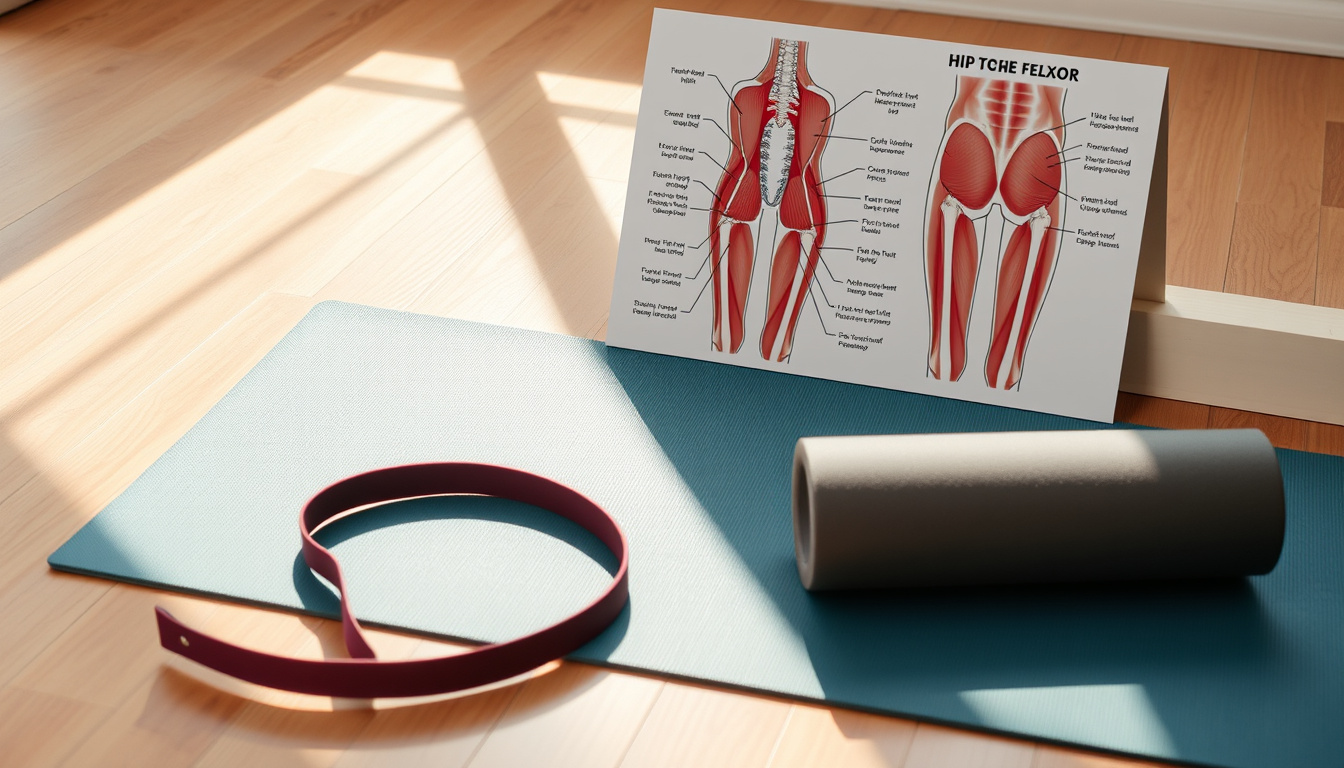

Anyone who has spent hours at a desk knows that stiff, achy feeling in the front of the hip when you finally stand up. That is your hip flexors demanding a little attention.
Sitting hours linked to tightness: More than 6 hours/day ·
Stretches recommended by HSS: 4 ·
Hip flexor strain recovery time: 1–6 weeks ·
Adults with low back pain linked to tight hip flexors: ~80% (CDC estimate) ·
Number of hip flexor exercises in Healthline guide: 8
Quick snapshot
- Stretching reduces hip flexor tightness and improves mobility (Harvard Health)
- Prolonged sitting is a primary cause of tight hip flexors (Hospital for Special Surgery)
- Hip flexor strains heal with rest and graded exercise (WebMD)
- Direct link between specific emotions and hip flexor tension is not scientifically established (Dani Winks Flexibility)
- Efficacy of “30-second pain relief” stretches is not universally supported (Harvard Health) (Dani Winks Flexibility)
- Strain recovery: Grade I (mild) — 1 to 2 weeks; Grade II (moderate tear) — 2 to 4 weeks; Grade III (severe rupture) — 4 to 6 weeks or longer (WebMD) (Healthline)
- Regular stretching can improve tightness in days when combined with glute strengthening (Healthline)
- Integrate stretching into daily routine — every 30–45 minutes of sitting, change position (Hospital for Special Surgery)
- Pair stretches with core and glute strengthening for lasting relief (Harvard Health)
Five key facts about hip flexor anatomy and recovery, one pattern: the iliopsoas group does more work than most people realize, and recovery speed depends on how early you intervene.
| Label | Value |
|---|---|
| Anatomy | Hip flexors include iliopsoas, rectus femoris, sartorius (Harvard Health) |
| Common cause | Prolonged sitting (>6 hours/day) (Hospital for Special Surgery) |
| Strain grading | Grade I: mild, Grade II: moderate tear, Grade III: severe rupture (WebMD) |
| Recovery timeline | Strain: 1–6 weeks; tightness: can improve in days with consistent stretching (Healthline) |
| Prevalence | Tight hip flexors affect a majority of sedentary office workers (Harvard Health) |
The data table above draws from orthopedic and rehabilitation sources, and the recovery figures underscore why early intervention changes outcomes.
How do you release a tight hip flexor?
Releasing a tight hip flexor is not about yanking your leg into a stretch until it hurts. The most effective approach combines lengthening the muscle while activating its opposite muscle group — the glutes. Here are the top techniques from orthopedic sources, with exact hold times and mechanics.
Best hip flexor stretch: the kneeling version
- Kneel on one knee with the other foot flat on the floor, front leg at a 90-degree angle. Squeeze the glute of the rear leg and gently push your hips forward. Hold for 30 seconds per side, breathing steadily (WebMD).
- For a deeper variation, extend the hold up to 60 seconds total per side, as recommended by Harvard Health (Harvard Medical School’s consumer health publication).
- Add activation by imagining you are squeezing your front heel and back knee toward each other for 10 seconds before releasing deeper into the stretch (Dani Winks Flexibility).
How long should you hold a hip flexor stretch?
- Static holds of 30 to 60 seconds are the standard for improving flexibility, according to Harvard Health.
- Shorter holds of 10 to 30 seconds work for the floor-based variation where you lie on your back and pull one knee to your chest while pressing the opposite leg into the floor (Harvard Health).
- Repeat each stretch 2 to 4 times per side, resting briefly between repetitions.
A desk worker who holds a kneeling stretch for 30 seconds with glute engagement activates the reciprocal inhibition reflex — the glute fires, the hip flexor relaxes. That mechanical handshake is what actually releases the muscle, not just pulling harder.
The implication: precise glute engagement matters more than stretch intensity when releasing the hip flexor.
What are the symptoms of tight hip flexors?
Tight hip flexors do not always announce themselves with obvious pain. Many people feel a dull ache in the front of the hip, notice stiffness after sitting for more than 20 minutes, or struggle to stand up straight without arching their lower back. Recognizing these signals early can prevent compensation patterns that lead to bigger problems.
- Pain or discomfort in the front of the hip, especially when walking or standing after prolonged sitting (Harvard Health).
- Stiffness that makes it hard to fully extend the hip joint when standing upright (Hospital for Special Surgery).
- A feeling of “tightness” in the front of the thigh or groin area that does not go away with light movement.
What can be mistaken for hip flexor pain?
Hip flexor pain is a frequent mimic. Several conditions produce almost identical discomfort in the front of the hip and groin, making differential diagnosis essential.
- Hip osteoarthritis — pain is deeper and often accompanied by stiffness in the morning and a grinding sensation (WebMD).
- Groin strain — more localized to the adductor muscles of the inner thigh, often from a sudden movement or sports injury.
- Lumbar spine issues — referred pain from the lower back can wrap around to the front of the hip, making it feel like a hip flexor problem (Healthline).
- Inguinal hernia — a bulge in the groin may present with hip-like discomfort, especially during lifting or straining.
Because hip flexor pain overlaps with so many other conditions, self-diagnosis is risky. A physical therapist or sports medicine doctor can distinguish between a tight muscle, a torn tendon, and referred pain from the spine — three very different treatment paths.
What is the root cause of tight hip flexors?
Understanding why hip flexors tighten is the foundation of preventing it. The root cause is almost always positional: when you sit, your hip flexors remain in a shortened, contracted state for hours at a time. Over weeks and months, the muscle fibers adapt to that shortened position and resist lengthening.
What activities worsen tight hip flexors?
- Prolonged sitting — the most common culprit. Harvard Health notes that desk workers who sit more than six hours per day are especially vulnerable.
- Cycling — the hip is held in a flexed position for extended periods, which can shorten the hip flexors over time if stretching is neglected.
- Running — especially sprinting and hill running, which demand explosive hip flexion without giving the muscle a full range of motion on the extension side.
- Repeated kicking movements common in soccer and martial arts can overwork and tighten the hip flexors.
- Weak glutes and core contribute to hip flexor imbalance. When the glutes do not fire properly, the hip flexors take on extra stabilizing work and become chronically tight (Healthline).
For the average office worker, the equation is simple: eight hours of sitting + weak glutes = chronically tight hip flexors. The fix is not just stretching more — it is breaking the sitting cycle every 30 to 45 minutes, as HSS recommends, and building glute strength through bridges and planks (Hospital for Special Surgery).
The pattern: sitting duration and glute weakness compound each other, making the hip flexor a secondary casualty of a sedentary workday.
How to fix a pinched nerve in hip flexor?
Sometimes what feels like hip flexor tightness is actually a pinched nerve — and the treatment is different. The femoral nerve and lateral femoral cutaneous nerve both pass near the hip flexor muscles, and when they get compressed, the symptoms can mimic a muscle problem.
Can a pinched nerve in the hip be treated without surgery?
- Conservative treatment is the first line: rest from aggravating activities, gentle stretching of the hip flexors and hamstrings, and nerve gliding exercises that help the nerve move freely through the surrounding tissue.
- Physical therapy focusing on core and hip stabilization often resolves the compression without surgical intervention. Western Orthopaedics notes that many pinched nerves respond well to nonsurgical care (WebMD).
- “Differential diagnosis is important,” says a physical therapist at the Hospital for Special Surgery. “Pinched nerve symptoms — tingling, numbness, burning — differ from the dull ache of tight muscles.”
- If conservative treatments do not help after 4 to 6 weeks, imaging and further evaluation may be needed to rule out structural causes.
The implication: nerve-related hip pain requires targeted nerve gliding work, not just muscle stretching, and typically resolves with conservative care.
What emotion is held in the hip flexor?
This is the question that sits at the intersection of anatomy and mind-body practice. Some physical therapists, yoga instructors, and somatic practitioners observe that the hip flexors — particularly the psoas muscle — can hold patterns of tension linked to stress, fear, and emotional trauma. The science is not settled, but the anecdotal evidence is widespread enough to warrant a measured look.
How to release trauma from hips?
- Somatic exercises that combine slow, mindful movement with breath awareness are commonly recommended. The idea is to move the hip through its full range of motion while staying present to any emotional sensations that arise.
- Gentle stretching — the same kneeling and supine stretches described above — done with a focus on relaxation rather than force may help release both physical and emotional holding patterns.
- Some practitioners recommend lying on your back with knees bent, feet flat, and allowing the knees to gently fall side to side — a “psoas release” that invites the deep hip flexor to let go.
- Scientific evidence linking specific emotions to the hip flexors is limited. According to Dani Winks Flexibility, the emotional release framework is best approached as complementary practice, not a replacement for medical treatment.
The implication: for anyone dealing with chronic hip tightness that does not respond to standard stretching, exploring the mind-body connection may offer a useful additional lens — but the foundation should always be evidence-based mechanical release and strengthening.
Confirmed facts
- Stretching reduces hip flexor tightness and improves mobility (Harvard Health)
- Prolonged sitting is a primary cause of tight hip flexors (Hospital for Special Surgery)
- Hip flexor strains heal with rest and graded exercise (WebMD)
What remains unclear
- Direct link between specific emotions and hip flexor tension is not scientifically established (Dani Winks Flexibility)
- Efficacy of “30-second pain relief” stretches is not universally supported (Harvard Health)
“Hold each hip flexor stretch for 30 seconds and combine it with glute strengthening for the best results. The glute is the brake for the hip flexor — if it is weak, the flexor never gets permission to relax.”
— Physical therapist, Hospital for Special Surgery
“Hip flexor stretches are especially important for people who sit most of the day. Even two minutes of stretching every hour can significantly reduce the stiffness that builds up over a workday.”
— Harvard Health Publishing
“After a hip flexor strain, start with gentle range-of-motion exercises and progress to strengthening only when you can move without pain. Rushing back to activity is the most common reason for re-injury.”
— My Health Alberta, Government of Alberta health service
The pattern across all three sources is consistent: the hip flexor responds best to a combination of precise stretching and supportive strengthening. For anyone who sits more than they move, the choice is straightforward — build a habit of short, frequent releases and glute activation, or accept the gradual creep of tightness into your lower back and gait. The desk worker who sets a timer to stretch every 30 to 45 minutes and adds three sets of glute bridges to their evening routine is not being obsessive: they are matching the mechanical reality of their day.
For a comprehensive approach to loosening tight hips, the hip flexor stretch guide provides detailed step-by-step instructions and relief tips.
Frequently asked questions
How often should I stretch my hip flexors?
Daily stretching is ideal, especially if you sit for long periods. Aim for 2 to 3 sessions per day, holding each stretch for 30 to 60 seconds per side (Harvard Health).
Can tight hip flexors cause lower back pain?
Yes. Tight hip flexors pull the pelvis into an anterior tilt, which increases the curve of the lower back and can strain the lumbar spine. This is one of the most common postural links in desk workers (Hospital for Special Surgery).
Is walking good for tight hip flexors?
Walking helps maintain hip mobility but is not enough to release chronically tight hip flexors on its own. It works best as a complement to targeted stretching and glute strengthening (Healthline).
What is the best time of day to stretch hip flexors?
Morning stretching can help counteract overnight stiffness, while evening stretching releases tension accumulated from sitting all day. The best time is whenever you can be consistent (WebMD).
Should I stretch a sore hip flexor?
Only if the soreness is from tightness, not a strain. If you have a Grade I or II strain, rest the muscle for 1 to 3 days before attempting gentle stretching. Pain during a stretch is a signal to stop (WebMD).
Can hip flexor tightness lead to knee pain?
Yes. When the hip flexors are tight, the quadriceps and hamstrings can compensate, altering the tracking of the kneecap and contributing to patellofemoral pain (Healthline).
Are there any risks to overstretching hip flexors?
Overstretching can irritate the hip joint, strain the iliopsoas tendon, or cause instability if the muscle is lengthened without sufficient glute strength to stabilize the joint. Always stretch within a pain-free range (Hospital for Special Surgery).
What alternative exercises can help loosen hip flexors?
Pigeon pose in yoga, lunges with a torso twist, and supine knee-to-chest variations all target the hip flexor group from different angles. The bridge exercise also strengthens the glutes, which helps the hip flexors lengthen more effectively (Healthline).

Rachel Walsh leads fact-checking, source verification and corrections at Aussie Pulse.