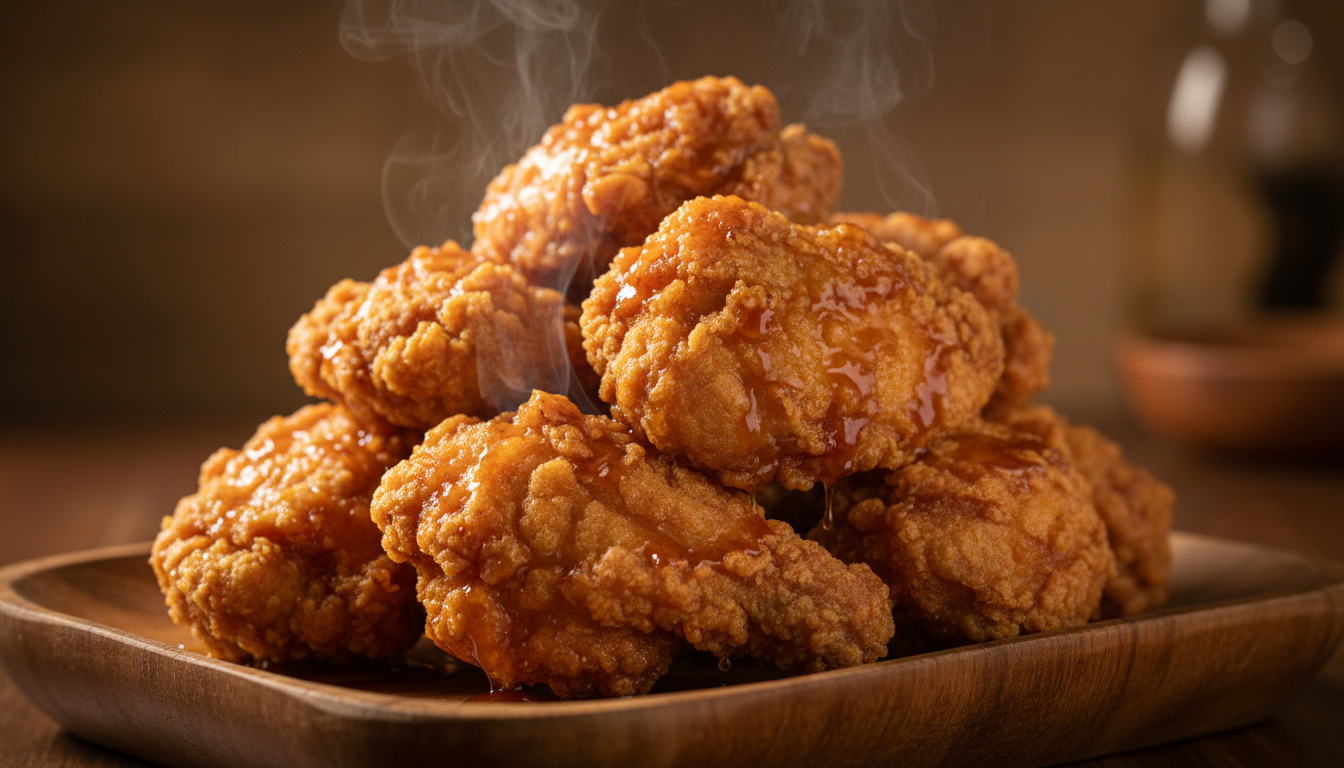

The shatteringly crisp crust yields with an audible crack, revealing juicy meat beneath a lacquer of sweet-spicy glaze. This sensory experience defines Korean fried chicken, a culinary export that has colonized cities from New York to Jakarta through a distinctive double-fry technique and an obligatory beer pairing known as chimaek.
Unlike its American predecessor, this iteration prioritizes textural contrast over heavy breading. The dish emerged not from centuries of tradition, but from post-war adaptation and 1970s economic shifts, now supported by over one hundred specialized chains in its homeland alone.
What Is Korean Fried Chicken?
At its core, Korean fried chicken represents a methodological departure from Western traditions. The protein undergoes double-frying at precisely 180°C, first to cook through, then to dehydrate the exterior into a glass-like shatter. This creates the signature huraideu (plain) style, though most consumers encounter it coated in yangnyeom (sweet-spicy) or ganjang (soy-garlic) glazes.
Two-stage frying creates paper-thin, crackling skin without heavy batter.
Yangnyeom and ganjang glazes applied post-frying for layered flavor.
Mandatory accompaniment with cold lager beer as social ritual.
Born from post-war oil accessibility and American military influence.
- Potato starch coating replaces wheat flour for lighter, less greasy results.
- Sauce immersion happens after frying, preserving structural integrity.
- Pickled radish serves as the traditional palate cleanser alongside orders.
- Draft beer cuts through salt and fat, enabling extended consumption.
- Kyochon and Bonchon chains standardized quality for global export.
- Chi-neunim slang elevates the dish to god-like status in modern Korea.
- Bite-sized portions dominate, contrasting with American whole-bird service.
| Attribute | Details |
|---|---|
| Origin Period | 1970s South Korea |
| Primary Technique | Double frying at 180°C |
| Coating Starch | Potato starch (not wheat) |
| Signature Sauces | Yangnyeom, Ganjang |
| Cultural Term | Chimaek (chicken + beer) |
| Historic Pricing | ₩3,400 (chicken), ₩450 (beer) |
| Global Chains | Kyochon (1991), Bonchon |
| Production Growth | 13-fold increase since origin |
Why Is Korean Fried Chicken So Crispy?
The textural superiority stems from thermodynamic precision. A single fry cooks the meat but leaves moisture trapped in the batter. The Korean method implements a resting period between two high-temperature immersions, allowing steam to escape before the final crystallization of the coating.
The Double-Fry Methodology
Initial frying occurs at 180°C for five minutes, cooking the chicken through while forming a base crust. After resting on paper towels, the pieces return to the oil for two to three minutes. This second phase drives off remaining water content, creating the characteristic shatter rather than chew, as documented by Bonchon’s historical analysis.
Potato Starch Chemistry
Traditional American recipes rely on wheat flour batters, which produce thicker, more absorbent coatings. Korean vendors utilize potato starch, which gelatinizes differently, creating a thinner, more transparent barrier that resists oil saturation while amplifying crunch, according to culinary documentation.
Maintaining oil at exactly 180°C proves critical. Deviation below this threshold results in oily, sodden coating, while excessive heat burns the exterior before the interior reaches safe temperatures.
How to Make Korean Fried Chicken at Home
Replication requires attention to oil management and sauce timing. The home cook must resist the urge to crowd the pot, as temperature drops destroy the critical Maillard reaction responsible for color and texture.
Ingredients and Preparation
For 1.5 kilograms of boneless chicken thighs, combine two tablespoons of rice wine with two teaspoons of grated ginger and one teaspoon each of onion powder, garlic powder, salt, and black pepper. Marinate the meat briefly, then dredge in one cup of potato starch immediately before frying.
The Frying Process
Heat neutral oil to 180°C. Fry the chicken in batches for five minutes, then rest on a wire rack. Allow the oil to return to temperature, then refry for two to three minutes until golden. This resting intervals prove as crucial as the frying itself.
Sauce Application
Prepare yangnyeom sauce by combining gochujang, honey, soy sauce, minced garlic, and sesame oil over low heat until thickened. Toss the freshly fried chicken in the glaze immediately before serving to preserve the crust’s integrity. Detailed proportions vary by household, notes cultural culinary sources.
Never exceed pot capacity beyond one-third full with oil. Double-frying increases oil degradation; filter between batches and discard if smoke appears.
Korean Fried Chicken vs. American Fried Chicken
The divergence extends beyond technique into cultural function. While both utilize fried poultry, the Korean variant functions as a delivery mechanism for sauce and a vehicle for beer consumption, whereas American styles often stand alone as hearty meals.
| Aspect | Korean Fried Chicken | American Fried Chicken |
|---|---|---|
| Frying Technique | Double-fry for ultra-crispy, light texture | Single-fry with thicker batter |
| Coating Composition | Potato starch, thin and crackly | Wheat flour, thick and seasoned |
| Sauce Application | Applied post-frying, sticky glaze | Pre-seasoned or gravy accompaniment |
| Serving Style | Bite-sized pieces, shared plates | Whole pieces, individual portions |
| Cultural Context | Late-night drinking snack (anju) | Meal centerpiece, often midday |
| Primary Beverage | Cold lager beer (chimaek) | Soft drinks or sweet tea |
American fried chicken descended from Scottish and West African traditions brought to the Southern United States centuries ago. The Korean adaptation emerged specifically in the 1970s through post-war oil importation, making it a distinctly modern invention despite ancient Korean precursors like Pogye.
History and Origins of Korean Fried Chicken
The narrative begins not in ancient kitchens, but in military bases. Following the Korean War, American GIs stationed in South Korea introduced deep-frying techniques to local populations accustomed to boiling or grilling poultry.
-
Post-Korean War American military presence introduces deep-frying methods to Korean cooks, as recorded by Wikipedia’s chimaek entry.
-
Roasted chicken variants appear, adapting to local flavor preferences before frying becomes economically viable.
-
Cooking oil imports make widespread deep-frying affordable; whole fried chickens appear in markets for ₩3,400.
-
Rims Chicken brand founded, marking the beginning of commercial specialization, documented by Korean cultural archives.
-
The term chimaek enters common parlance as fried chicken and draft beer consumption surges nationwide.
-
Kyochon establishes operations, later credited with perfecting the yangnyeom sauce formula for mass distribution.
-
The Korea-Japan World Cup triggers massive chimaek consumption as fans gather to watch matches, cementing the tradition nationally.
-
Global expansion accelerates through chains like Bonchon; ancient texts referencing 1459 Pogye (stir-fried chicken) are rediscovered, though modern chimaek remains a 20th-century phenomenon.
What Is Certain and What Remains Speculative
Clear documentation supports the technological and cultural development of this cuisine. However, gaps persist in attributing specific inventions to individuals or establishing standardized nutritional data.
| Established Information | Uncertain or Debated |
|---|---|
| Double-frying at 180°C is the industry standard | The specific individual who invented the technique |
| Potato starch produces the characteristic texture | Precise caloric content per serving (varies by sauce) |
| Yangnyeom sauce developed in the 1970s | Extent of influence from ancient Pogye recipes |
| Chimaek culture surged during the 2002 World Cup | Whether “Chi-neunim” slang originated in specific regions |
| Oil imports in 1971 enabled mass availability | Health comparisons to single-fried chicken |
The Cultural Mechanics of Chimaek
Chimaek transcends mere food pairing to constitute a social institution. The portmanteau of “chikin” (chicken) and “maekju” (beer) describes a ritualized consumption pattern where salty, crispy protein balances fizzy, low-alcohol lagers like Cass or Hite. This combination facilitates extended socializing without rapid intoxication or palate fatigue.
The practice reshaped South Korean nightlife, creating a specific category of restaurant serving exclusively chicken and beer. Post-work gatherings, sports viewings, and casual dates occur within these specialized venues, where pickled radish banchan provides acidic contrast to reset the taste buds between bites and sips, as described by culinary analysts.
While researching regional food tourism, one might consider how Springbrook National Park – Walks, Waterfalls and Glow Worms offers similar sensory experiences in natural settings, though the urban chimaek phenomenon remains distinctively metropolitan.
Historical Documentation and Sources
Primary verification derives from economic records showing cooking oil importation timelines and brand founding dates. Contemporary accounts from the 2002 World Cup provide photographic and journalistic evidence of chimaek’s cultural saturation.
“Chicken production rose thirteen-fold with economic growth, earning the slang designation Chi-neunim—a portmanteau of chicken and God—reflecting the dish’s elevated status in modern Korean society.”
— Cultural Encyclopedia Entry
The Global Expansion of Crunch
Korean fried chicken continues its trajectory from post-war necessity to global luxury snack. The methodology’s emphasis on textural precision and the chimaek ritual’s social functionality have proven universally adaptable, even as waistlines and Suits for Men – Best 2025 Styles Fits and Brands Under $500 remain separate concerns for the health-conscious diner.
Frequently Asked Questions
Is Korean fried chicken inherently spicy?
Not necessarily. Plain fried chicken (huraideu) contains no spice. Only yangnyeom variations carry heat from gochujang. Ganjang offers a savory, non-spicy alternative.
What distinguishes yangnyeom from ganjang?
Yangnyeom combines sweet and spicy elements using gochujang and honey. Ganjang utilizes soy sauce and garlic for umami depth without chili heat.
Can cornstarch substitute for potato starch?
Cornstarch produces a similar crispness but lacks the delicate, glass-like quality of potato starch. Results will be acceptable but texturally distinct.
How many calories does a typical serving contain?
Specific data remains unavailable. General estimates suggest 250-350 calories per 100 grams, though sauce and oil absorption create significant variation.
What does the term chimaek specifically mean?
The portmanteau combines “chikin” (the Korean pronunciation of chicken) and “maekju” (beer), describing the specific act of consuming both simultaneously.
Why is pickled radish served alongside orders?
The acidic, sweet brine cuts through oil coating the palate, enabling continuous eating without flavor fatigue during extended beer consumption.
Does the double-fry method reduce oil absorption?
Paradoxically, no. The technique increases oil contact time. Claims of reduced fat content compared to single-frying remain unsubstantiated by nutritional studies.

Rachel Walsh leads fact-checking, source verification and corrections at Aussie Pulse.