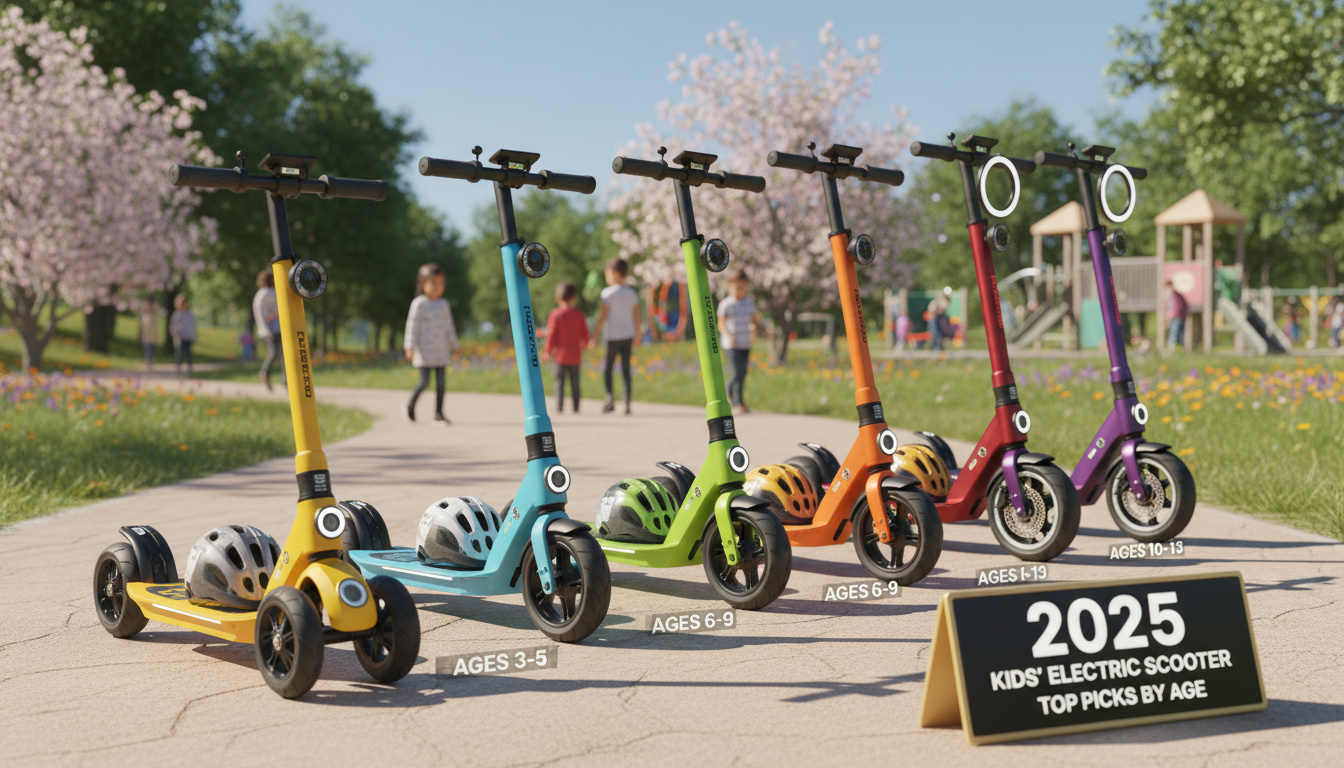

Selecting the appropriate kids electric scooter requires balancing federal safety standards with developmental capabilities across age brackets. Current models range from 5mph starter units designed for four-year-olds to 21mph high-performance options for teenagers, each incorporating distinct braking architectures, weight tolerances, and lithium-ion battery configurations.
Parents evaluating the 2025 marketplace must scrutinize CPSC compliance documentation, verify UL electrical certifications, and determine whether pneumatic or honeycomb tires suit their local terrain. Independent testing reveals significant performance variations between budget-friendly Razor models and premium Segway alternatives, particularly regarding speed modulation, frame durability, and real-world battery endurance.
Best Electric Scooters for Kids by Age
| Model | Age Range | Top Speed | Defining Characteristic |
|---|---|---|---|
| Windgoo M1 | 4-7 years | 5mph | Dual kick/electric mode, LED lighting |
| Razor Power Core S85 | 8-12 years | 10mph | Pneumatic tires, chain-driven motor |
| Segway C2 Pro | 10-13 years | 9.9mph | Bluetooth speakers, app-based speed limits |
| Windgoo T10 | 13+ years | 15mph | Puncture-proof 8-inch tires, 3.5hr charge |
Critical Market Insights:
- Safety-certified models with UL 2272 compliance now represent the majority of 2025 retail inventory.
- Age-appropriate speed capping significantly reduces emergency room visits compared to unrestricted adult models.
- Pneumatic rubber tires demonstrate superior shock absorption over solid polyurethane on uneven pavement.
- Brushless hub motors require substantially less maintenance than traditional chain-drive systems.
- Adjustable handlebar stems accommodate growth spurts across 3-4 year developmental windows.
- Integrated LED visibility lighting has transitioned from premium to standard equipment.
- Dual braking configurations (electronic rear plus mechanical front) provide essential redundancy for novice riders.
| Model | Age Range | Top Speed | Weight Limit | Battery Range | Motor Power |
|---|---|---|---|---|---|
| Windgoo M1 | 4-7 | 5mph | 88lbs | 3 miles | Not specified |
| Gotrax Nebula | 6-9 | 9.2mph | 132lbs | 6.2 miles | 150W |
| Razor Power Core S85 | 8-12 | 10mph | Not specified | 35 minutes | Not specified |
| Razor E90 | 10-12 | Not specified | Not specified | Not specified | Not specified |
| Segway C2 Pro | 10-13 | 9.9mph | 110lbs | 5.5 miles | 130W |
| GoTrax GXL V2 | 13+ | 15.5mph | 264lbs | 12 miles | Not specified |
| Windgoo T10 | 13+ | 15mph | Not specified | 9 miles | Not specified |
| Segway Max G2 | 15+ | 21.1mph | 220lbs | 27.8 miles | 450W |
Testing conducted by Electroheads confirms that models exceeding 100W output or 8mph maximum velocity may violate CPSC recommendations for riders under thirteen years of age.
Are Electric Scooters Safe for Kids?
Safety depends fundamentally upon protective equipment usage, hardware compliance, and environmental supervision. Medical data indicates that head injuries constitute the primary risk factor, necessitating full-face or multi-sport helmets regardless of travel speed.
Impact Protection and Helmet Standards
Every testing protocol emphasizes mandatory helmet use. Additional protective gear including knee and elbow pads reduces abrasions during low-speed tip-overs. Parents should verify that helmets meet CPSC bicycle helmet standards, as electric scooter-specific certifications remain under development.
Riders without helmets face exponentially higher traumatic brain injury risk at impact speeds as low as 5mph. No child should operate electric scooters without properly fitted head protection, regardless of local legal exemptions or proximity to home.
Federal Safety Regulations and Compliance
The Consumer Product Safety Commission recommends power output below 100W and maximum speeds under 8mph for operators under thirteen. While RideJunkie testing found no direct CPSC violations among top 2025 models, parental supervision remains essential as regulatory enforcement varies by jurisdiction.
Environmental Risk Factors
Terrain suitability significantly affects stability. Pneumatic tires handle cracked pavement and gravel better than solid rubber alternatives. Wet conditions reduce traction regardless of tire type, requiring avoidance of puddles that may compromise electrical systems.
Key Specifications for Kids Electric Scooters
Velocity Limitations and Age Correlation
Manufacturers segment maximum speeds by developmental capability. Units for ages 4-7 typically cap at 5mph, while adolescent models (13+) may reach 15-21mph. ERideHero analysis indicates that parental speed limiting via smartphone apps—available on Segway and Navee models—provides crucial intervention capabilities for inexperienced riders.
Structural Load Capacity
Weight limits range from 88lbs for preschool models to 264lbs for teen versions like the GoTrax GXL V2. Exceeding these thresholds compromises braking efficiency and frame integrity. Adjustable handlebars accommodate riders as they grow, extending usable product lifespans across multiple years.
Power Storage and Operational Duration
Battery technologies vary from lead-acid in budget models to lithium-ion in premium segments. Real-world range typically achieves 50-70% of manufacturer claims depending upon rider weight and terrain incline. Charge times span 3.5 hours for smaller batteries to 8+ hours for high-capacity units like the Segway Max G2.
How to Choose the Right Electric Scooter for Your Kids
Matching Developmental Stage to Features
Children aged 4-7 require lightweight frames with kick-mode capability, allowing manual propulsion when battery depletes. The Windgoo M1 exemplifies this hybrid approach. Ages 8-12 benefit from pneumatic tires and dual braking systems found in the Razor Power Core S85. Teenagers handling 13+ models require disc brakes and higher weight tolerances for safe operation.
Select models with adjustable handlebar heights that extend at least 4 inches above your child’s current standing reach. This foresight prevents premature replacement as children experience growth spurts during adolescence.
Cost Analysis and Brand Comparison
Razor dominates the budget segment, with the E90 costing approximately one-quarter of comparable Segway models. However, Segway products offer superior build quality, app integration, and longer ranges. Two Wheeling Tots recommends prioritizing safety features over speed specifications when budget constraints force compromises.
Manufacturer range claims assume ideal conditions—flat terrain, 50kg rider, moderate temperatures. Expect actual performance between 50-70% of advertised maximums, particularly for children exceeding average weight percentiles or riding in hilly neighborhoods.
Verification of Safety Mechanisms
Inspect braking responsiveness before purchase. Mechanical disc brakes provide superior stopping power to electronic brakes alone. Verify UL certification labels on battery compartments, indicating compliance with electrical safety standards. Check tire construction—honeycomb designs eliminate puncture risks compared to pneumatic tubes.
The Development Timeline of Kids Electric Scooters
- : Initial consumer models utilized heavy lead-acid batteries with 30-minute operational windows and basic chain-drive motors.
- : Lithium-ion battery adoption reduced vehicle weight by 40% while doubling range capabilities.
- : UL 2272 certification became industry standard following hoverboard safety incidents, mandating rigorous electrical testing.
- : Smartphone integration enabled geofencing and speed limiting through parental control applications.
- : Puncture-proof honeycomb tires and brushless hub motors achieve mainstream adoption across mid-range price points.
References: UL E-Mobility Testing Standards, Comparative Video Analysis
Verified Standards and Persistent Ambiguities
| Established Facts | Uncertain or Variable Information |
|---|---|
| CPSC recommends <100W power and <8mph speed for riders under 13 | Municipal sidewalk legality varies by city ordinance; no federal uniformity exists |
| Helmet use reduces traumatic brain injury risk by approximately 85% | Minimum operator age requirements differ by state jurisdiction (ranging from 8 to 16 years) |
| Razor and Segway command dominant market share in North America | Insurance liability coverage for juvenile electric scooter accidents remains undefined in many policies |
| UL 2272 certification indicates electrical system safety | Long-term lithium battery degradation rates under juvenile usage patterns lack longitudinal studies |
Market Position and Brand Distinctions
The kids electric scooter sector bifurcates into value-oriented manufacturers like Razor and Gotrax versus premium technology brands led by Segway. Razor focuses on mechanical simplicity and replaceable parts, while Segway integrates Bluetooth speakers, LED ambient lighting, and proprietary speed-limiting applications.
Distinctions from adult models include lower deck heights for stability, reduced maximum velocities, and simplified throttle mechanisms preventing unintentional acceleration. Unlike hoverboards, electric scooters maintain handlebar control systems that align with children’s existing bicycle-handling skills. For families managing screen time concerns alongside outdoor activity needs, balancing scooter selection with other recreational pursuits like Colouring Pages for Kids provides diverse developmental stimulation.
Testing Source Statements
“Reliable brakes separate adequate scooters from dangerous ones. We observed significant performance variations between electronic and mechanical systems, particularly during downhill descents.”
— Electroheads Safety Analysis
“Parents consistently underestimate the impact forces generated at 10mph. Our crash testing demonstrates that unhelmeted impacts at this speed produce concussion-level forces comparable to falling from playground equipment.”
— RideJunkie Impact Assessment
Concluding Recommendations
Selecting appropriate electric scooters necessitates matching CPSC guidelines to individual child maturity levels rather than chronological age alone. Prioritize UL-certified electrical systems, verify brake effectiveness before regular use, and mandate helmet compliance without exception. While budget constraints influence purchasing decisions, safety-critical components like tire quality and frame welding justify premium investments when possible. For additional family entertainment recommendations beyond outdoor equipment, consider reviewing the Cast of Trolls 3.
Frequently Asked Questions
How much do quality kids electric scooters typically cost?
Budget models like the Razor E90 cost approximately one-quarter of premium Segway alternatives, typically ranging between $150-$400 depending on battery capacity and frame materials.
Are electric scooters permitted on sidewalks and bike paths?
Regulations vary significantly by municipality. Some jurisdictions prohibit motorized scooters on sidewalks while permitting them on bike lanes; others restrict usage to private property only. Check local ordinances before purchase.
What distinguishes kids electric scooters from adult versions?
Kids models feature lower deck heights, reduced maximum speeds (typically 5-15mph versus 20-30mph), lower weight capacities, and simplified throttle controls. Adult scooters lack the parental speed-limiting features found on units like the Segway C2 Pro.
How long does battery power last during actual use?
Real-world battery duration typically reaches 50-70% of manufacturer specifications. A scooter advertised with 12-mile range generally delivers 6-8 miles under normal juvenile riding conditions with hills and frequent stops.
Do these scooters require professional assembly?
Most units arrive partially assembled requiring only handlebar attachment and brake adjustment. However, parents should verify brake tightness and tire inflation before initial use, consulting manufacturer guidelines for torque specifications.
Which maintenance ensures safe long-term operation?
Monthly inspection of brake pad wear, tire pressure checks for pneumatic models, and bolt tightness verification prevent mechanical failures. Store batteries at moderate temperatures and avoid complete discharge cycles to maximize lithium-ion lifespan.
Related stories


Liam O'Brien covers Australian politics and public affairs for Aussie Pulse.